Stealth AI startup · confidential
Designing for the Agentic Era
Taking an idea from “what if” to “here, click this” fast enough that the company can decide what it's building.
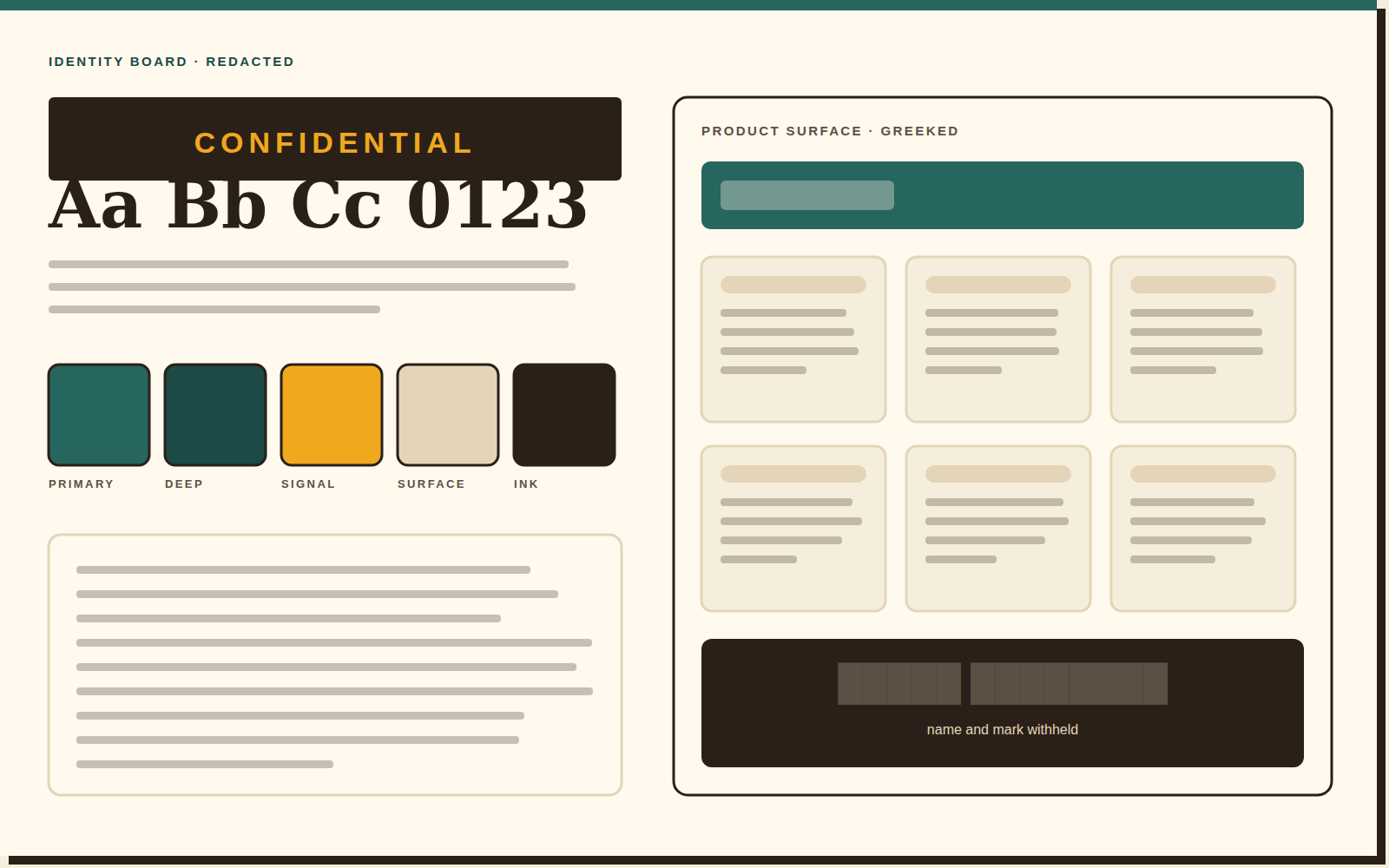
A note on what you're seeing. I take my clients' confidentiality seriously. The artifacts on this page are re-creations and abstractions of the real work, and the numbers are illustrative of project outcomes rather than audited figures. Happy to walk you through the genuine article — just ask.
The situation
A frontier AI company, pre-launch, with no established UX playbook — because nobody has one yet.
The core question was not “what should this screen look like.” It was: how do humans direct, trust, and collaborate with AI agents that are doing real work on their behalf? Every pattern we take for granted in ordinary software — handoff, oversight, confidence, correction, undo — had to be designed from first principles, for a kind of system that behaves differently every time you run it.
That is a genuinely hard place to design. There is no competitor to benchmark, no convention to lean on, and the underlying capability changes underneath you every few weeks. The only way through is to build the thing and look at it.
My role
I own product UX across the agent-facing surfaces: the interaction model, the orchestration patterns, and the prototypes that make an abstract capability arguable. I work directly with the founders and engineering, and I've carried the same thinking outward into identity, messaging and the company's public face — a full-stack design partner rather than a screen supplier.
The process
Beat one
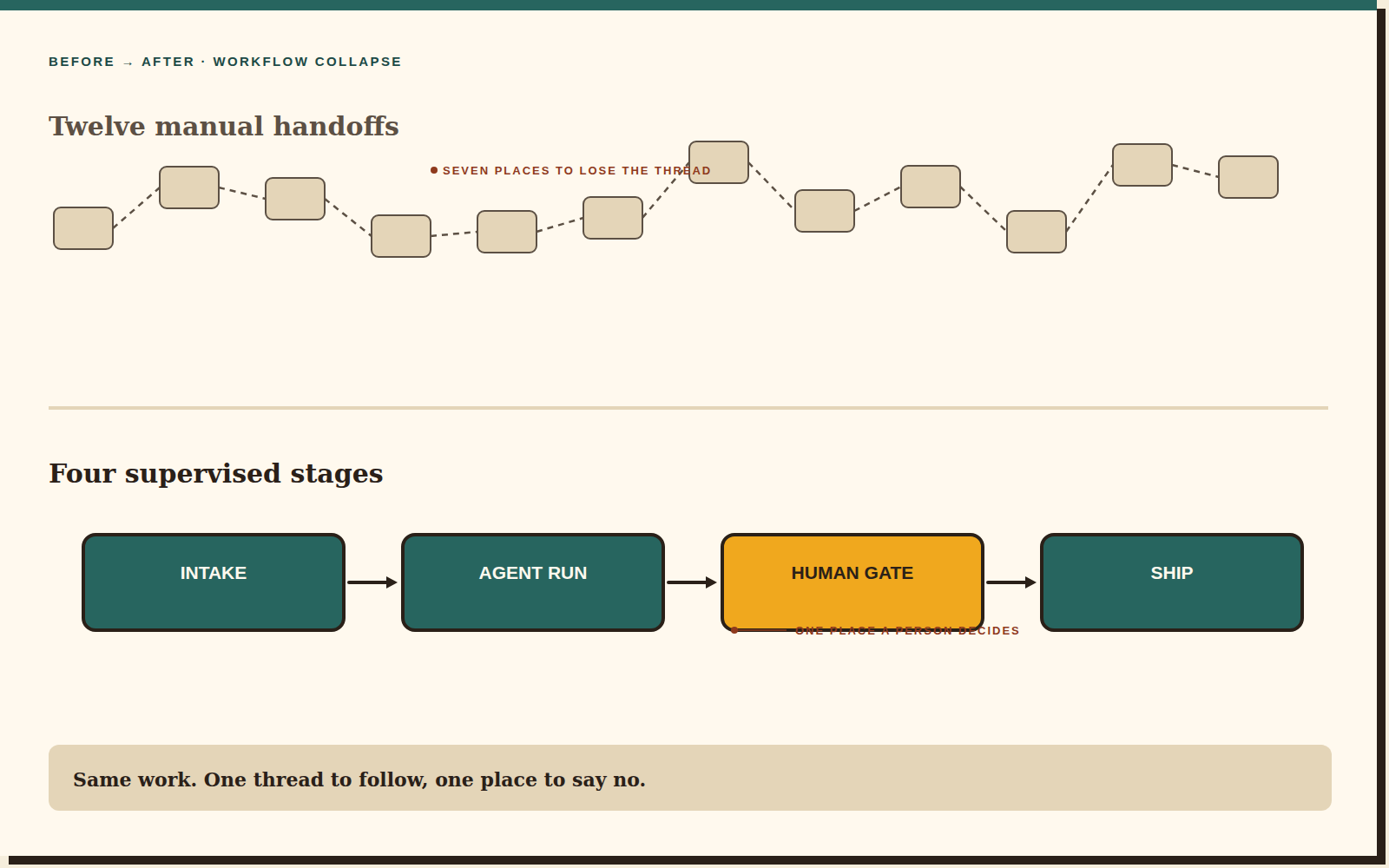
Ideation the old way and the new way
Whiteboards in the morning, AI-assisted exploration in the afternoon. Using agents to build the thing that uses agents turns out to be the fastest way to learn what the thing should be — you feel the failure modes personally instead of theorising about them.
Beat two
Orchestration design
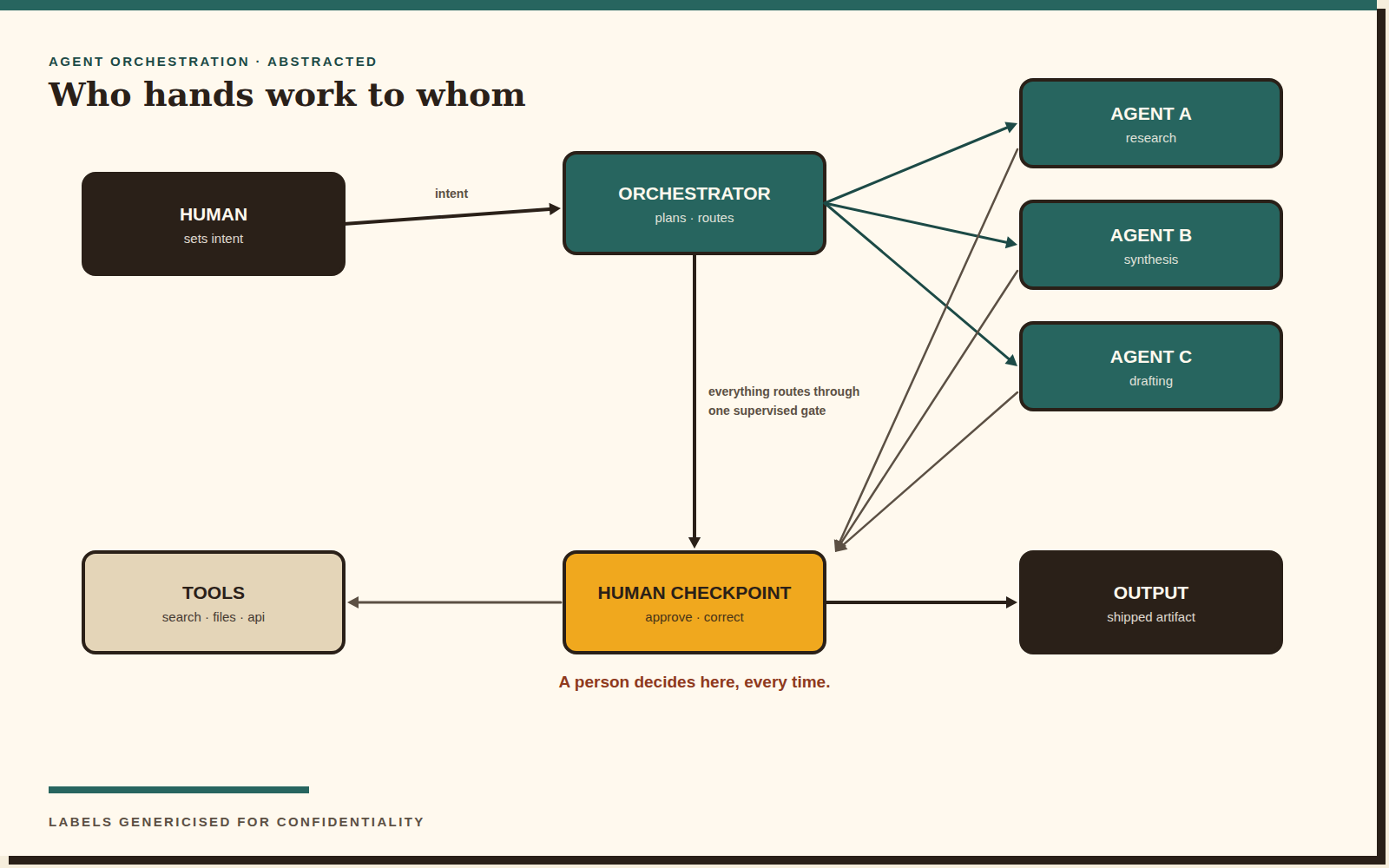
Mapping how multiple agents, tools and humans hand work to each other — who can start what, who has to approve, and what happens when an agent is confidently wrong. Most of the design work here is in the seams, not the surfaces.
Beat three
Rapid prototyping
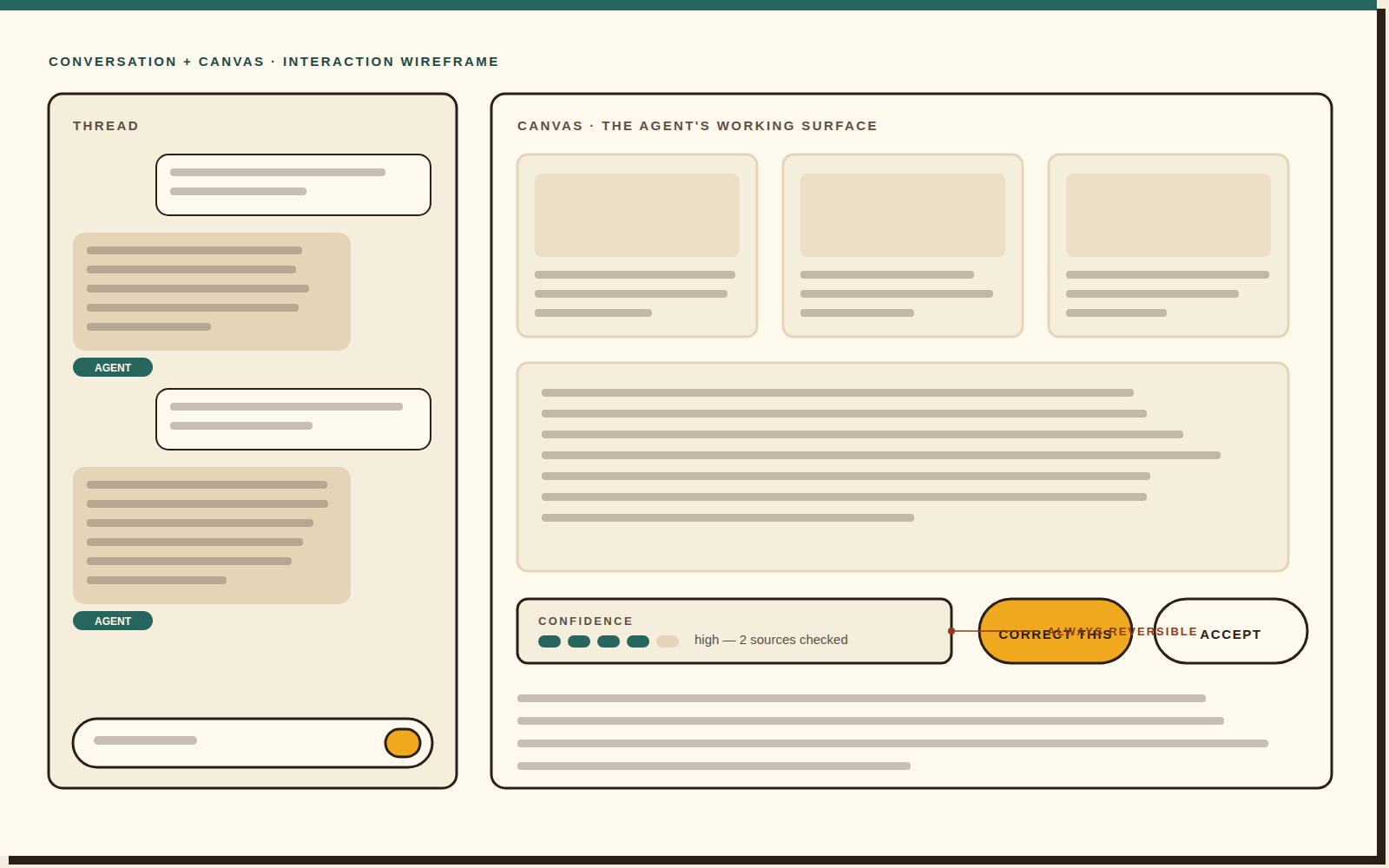
Concept to clickable, fast. Prototypes are the argument: when a pattern is real enough to use, the conversation stops being about opinion and starts being about behaviour. Several of those prototypes fed directly into patent drafting.
Beat four
Beyond the product
Identity, messaging, the website, go-to-market support. In a pre-launch company the product and the story are the same object, and it is much cheaper to design them together than to reconcile them later.
0→1*
The outcome
The work is confidential; the pattern is not. Take an idea from “what if” to “here, click this” fast enough that the company can decide what it's building. Several of those ideas are now in patent drafts.
Reflection
“Designing for AI feels like the early web — nobody knows the rules yet, and that's exactly the fun of it.”
The temptation is to make agents feel magical. The better instinct is to make them feel accountable: legible about what they did, honest about how sure they are, and trivially easy to overrule. Every time we chose accountability over magic, people trusted the system more and used it harder.